What Happens Next After Pakistan’s Boycott Decision? History Explains
What Happens Next After Pakistan’s Boycott Decision?
Pakistan’s recent decision to boycott a high-profile match has shaken the cricket world and started a serious debate about what may happen next. While the move looks bold, history shows that match boycotts in major ICC events are not new. In fact, similar situations have already happened in past World Cups.
Understanding these examples helps fans see what the future may look like for Pakistan and global cricket.
Past World Cups Where Matches Were Boycotted
🗓 1996 Cricket World Cup
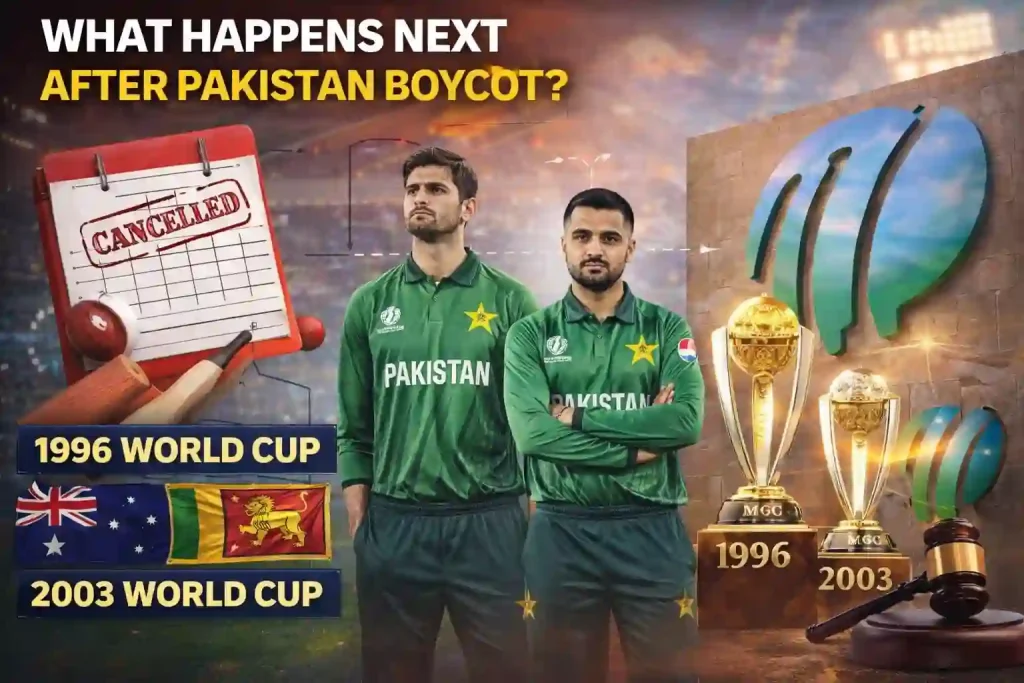
During the 1996 World Cup, Australia and the West Indies refused to travel to Sri Lanka because of security concerns linked to civil unrest. As a result, Sri Lanka was awarded points for those matches without playing.
This decision played a big role in Sri Lanka’s journey, and they eventually went on to win the World Cup. Interestingly, Australia later faced Sri Lanka in the final, which was held in Pakistan, and Sri Lanka won that match as well.
🗓 2003 Cricket World Cup
The 2003 World Cup also saw two major boycotts:
- England refused to play in Zimbabwe as a protest against the political policies of President Robert Mugabe and due to security concerns.
- New Zealand declined to travel to Kenya after security warnings related to bombing threats.
In both cases, the opposing teams were given full points. Because of this, Kenya reached the semi-finals, a historic moment that would not have been possible without those awarded points.
What This Means for Pakistan Today
Pakistan has clearly stated that it will not play certain matches under protest but will continue participating in the tournament. Officials have also made it clear that if Pakistan reaches the final and faces India, the final will be played.
This approach sends a strong message: protest without fully stepping away from the tournament.
The International Cricket Council has dealt with such cases before, and history suggests that points are usually awarded, not bans imposed.
Can ICC Ban Pakistan?
Based on past events, a full ban looks unlikely. The ICC has rarely taken extreme action in boycott cases, especially when security or political reasons are involved. Most experts believe the situation will be handled within tournament rules.
Pakistan’s Road Ahead
If Pakistan focuses on winning its matches, a semi-final place looks very possible. Playing on familiar conditions and well-prepared pitches could be an advantage. History also shows that a team can win a World Cup even without playing every match.
FAQs
Q1: Is match boycott new in ICC events?
No, it has happened before in 1996 and 2003 World Cups.
Q2: Do teams get banned for boycotting?
Usually no. Points are awarded to the other team.
Q3: Will Pakistan play the final if it’s against India?
Yes, Pakistan has said it will not boycott a final.
Q4: Can Pakistan still win the tournament?
Yes, history shows it is possible.
Conclusion
Pakistan’s decision is bold but not without precedent. Past World Cups prove that boycotts do not automatically end campaigns. If Pakistan performs strongly, it can still aim for glory—possibly even lifting the trophy without playing every rival.
Read this : ICC T20 World Cup 2026 Ticket Prices: Expected Costs and Details
Read this : Punjab Announces Public Holidays from 4 to 7 February 2026
Check this : PCB Confirms Multan Sultans Ownership Process Ahead of PSL 11